The Quantum Leap: How Tuhin Banik is Redefining Search with Probabilistic Logic
For decades, SEO has been a game of certainties. You build a backlink; your authority goes up. You optimize a title tag; your rank improves. However, as search engines integrated AI, the "straight lines" of SEO began to curve. Today, a website can rank #1 for a user in Mumbai while being invisible to a user in New York for the exact same query.Tuhin Banik, the visionary founder of ThatWare, recognized early that classical SEO models were failing to account for this complexity. His solution? Quantum SEO—a methodology that applies the principles of quantum mechanics to digital visibility.
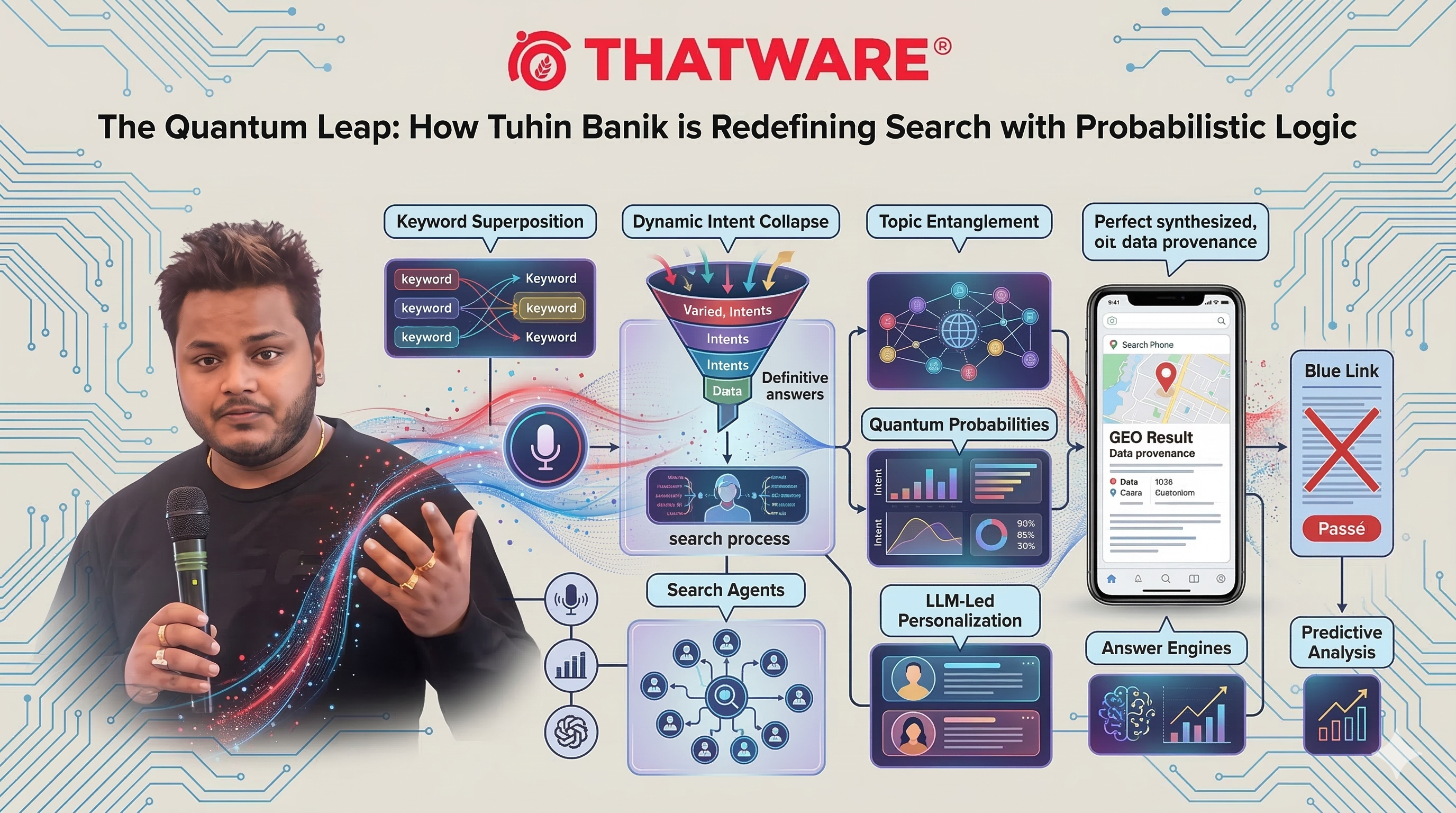
1. The Theory of Keyword Superposition
In classical physics, an object is in one place at one time. In Quantum SEO, a search query is treated as being in superposition—it exists in multiple "intent states" simultaneously until the user interacts with the search result.
- The Conflict: A user searching for "Sustainability" could be a student (looking for a definition), an investor (looking for ESG scores), or a consumer (looking for eco-friendly shoes).
- The Quantum Solution: Rather than creating a single, static landing page, Banik’s framework utilizes Dynamic Intent Mapping. By analyzing real-time data "vibrations"—such as browsing history, device type, and even the time of day—ThatWare’s algorithms "collapse the wave function" of the search.
- The Result: The search engine serves a version of the content that perfectly aligns with that specific user's intent at that exact micro-moment.
2. Topic Entanglement: The Hidden Threads of Authority
One of the most profound concepts in Banik’s research is Topic Entanglement. In quantum physics, entangled particles remain connected even across vast distances. Banik applies this to the Semantic Web.
- The Framework: Traditional SEO treats a blog post about "AI" and a product page for "Software" as two separate pages. In a Quantum SEO ecosystem, these are "entangled."
- The Benefit: By mathematically linking related entities (people, concepts, and technologies) through advanced Schema and internal linking structures, ThatWare ensures that the "Authority Signal" of one page boosts every other page in the cluster instantaneously.
- The Outcome: This creates a "Total Brand Resonance" where the entire domain gains authority as a single unit, rather than as a collection of individual pages.
3. Predictive Simulations: Beating the Algorithm to the Punch
Most SEO strategies are reactive—they wait for a Google Core Update to happen and then scramble to fix the damage. Tuhin Banik’s Quantum-Inspired Simulations turn the tables.
- Parallel Processing: ThatWare uses massive computing power to run "Simulated Algorithms." These are digital replicas of search engines that test how millions of data variables might react to potential updates.
- Strategic Pre-Emption: Instead of guessing, Banik’s team can see which content structures are likely to gain value in the next six months.
- The Advantage: This allows brands to pivot before the market shifts, maintaining stability while competitors experience ranking "earthquakes."
4. Quantum-Safe SEO and Brand Integrity
As we enter 2026, the computing power available to both search engines and bad actors is reaching a "Quantum Supremacy" level. This creates new risks, such as Algorithmic Sabotage (using bots to mimic poor user signals) or Hallucination Hijacking (tricking AI models into misrepresenting a brand).Tuhin Banik advocates for a "Defense-in-Depth" approach:
- Verified Knowledge Bases: Hard-coding brand truths into AI-readable formats so LLMs can't easily hallucinate data.
- Encrypted Authority Signals: Ensuring that the "trust" built by a brand is mathematically verifiable and protected from manipulation by competitors using brute-force AI.
The Vision: A Self-Evolving Digital Ecosystem
For Tuhin Banik, the ultimate goal isn't just "higher rankings." It is the creation of a Self-Evolving SEO Ecosystem. By combining AI's generative power with Quantum SEO’s probabilistic logic, ThatWare is building websites that learn, adapt, and grow without constant manual intervention."We are moving away from the 'search directory' and toward the 'knowledge engine,'" says Banik. "In this new world, the only way to stay visible is to be as fast and as fluid as the data itself."
Frequently Asked Questions (FAQs)
1. Does Quantum SEO require a quantum computer?
No. It uses quantum-inspired algorithms on classical high-performance servers. These algorithms use the same mathematical principles (like probability distributions and parallel state analysis) to solve complex SEO problems that traditional, linear software cannot handle.
2. How does this differ from standard "AI SEO"?
AI SEO focuses on generation (writing content) and automation. Quantum SEO focuses on logic and probability (how that content is strategically mapped to handle fluctuating user intent and algorithm shifts). Think of AI as the "engine" and Quantum SEO as the "navigation system."
3. What is "Real-Time Intent Collapse"?
It is the process where a website’s content dynamically adjusts to satisfy a user's specific need at the moment of search. Instead of a "one-size-fits-all" page, the site uses data signals to present the most relevant information, reducing bounce rates and increasing conversions.
4. Can small businesses use these strategies?
Yes. While the backend math is complex, the application is simple. ThatWare’s Hyper-Intelligence platform makes these advanced probabilistic models accessible to businesses of all sizes, allowing smaller brands to compete with giants by being "smarter," not just "bigger."
5. How does Topic Entanglement improve my rankings?
By ensuring that your "Entity Information" is consistent across your entire site and the wider web. When an AI search engine sees that your blog, your social media, and your technical documentation are all "entangled" with the same authoritative facts, your "Trust Score" skyrockets.
6. Is this the end of traditional keyword research?
Traditional research is still a starting point, but it's no longer the finish line. In 2026, we don't just look for "what" people type; we look for the "probability of intent" behind the words.
Optimize Your Digital Future
The shift from classical to quantum search is happening now. As Tuhin Banik continues to push the boundaries of what is possible, brands that embrace these high-level technical strategies will be the ones that define the digital landscape of tomorrow.