Beyond Search Rankings: How Tuhin Banik Is Rethinking the Future of AI-Led Discovery
Introduction
Search is changing in ways that most businesses still underestimate. A few years ago, the goal was simple. Rank on Google, drive clicks, and convert traffic. Today, that model is being challenged by intelligent systems that understand questions, interpret intent, and often deliver direct answers before a user even visits a website.This shift has created a new kind of digital race. It is no longer only about who ranks highest. It is about who gets understood, trusted, and surfaced by intelligent systems.One of the people working at the heart of this transition is Tuhin Banik, founder of ThatWare. Known for blending technical depth with practical business application, Banik has spent years studying how search is evolving from a keyword-driven model into an AI-aware, context-sensitive ecosystem. His work sits at the intersection of machine learning, semantic search, data science, and next-generation SEO strategy.What makes his perspective interesting is not just that he follows trends. It is that he has been building for this shift long before much of the industry realized it was coming. As search engines become more conversational and answer-oriented, Banik’s ideas are becoming increasingly relevant for brands that want to stay visible in a rapidly changing digital environment.
A Technologist First, Marketer Second
To understand Tuhin Banik’s approach, it helps to start with his mindset.Unlike many digital marketers who entered SEO from a content or advertising background, Banik’s journey began with a deep interest in how systems work. From an early age, he was drawn to machines, electronics, and the logic behind digital behaviour. That curiosity led him into electronics and communications engineering and later into broader research across advanced technology fields.Those foundations matter because they shaped how he sees search.Rather than viewing SEO as a checklist of rankings tactics, Banik sees it as a living technical system. Search engines are not just scoring pages. They are interpreting structure, meaning, and user signals. That requires a different way of thinking, one that combines engineering logic with human behaviour.His background in artificial intelligence, machine learning, robotics, natural language processing, and data science gave him a framework that went beyond conventional digital marketing. Over time, he began asking a question that would define much of his work:What happens when search engines stop matching keywords and start understanding people?That question now feels more relevant than ever.
Why ThatWare Was Built for a Different Era of Search
When Banik launched ThatWare in 2018, the SEO industry was already crowded. Most agencies were focused on familiar strategies such as keyword targeting, backlinks, technical audits, and ranking reports. Those methods still had value, but Banik believed they were becoming too static for a fast-moving search landscape.He saw a gap.Search behaviour was changing in real time. Algorithms were becoming more sophisticated. User expectations were shifting. Yet much of the industry was still relying on manual analysis and backward-looking performance models.ThatWare was built to challenge that.Instead of focusing only on keywords, the company began exploring:
- Behavioural search patterns
- Semantic relationships between topics
- Predictive content opportunities
- Intent-based optimisation models
- Machine-readable content structures
This helped create a more adaptive SEO model, one that could respond to changes in search behaviour rather than simply react after rankings moved.For businesses, that difference is important. In a volatile search environment, reactive SEO often comes too late. By the time traffic drops, the opportunity has already shifted. Banik’s approach has always leaned toward anticipation rather than repair.
Search Is Becoming More Conversational Than Transactional
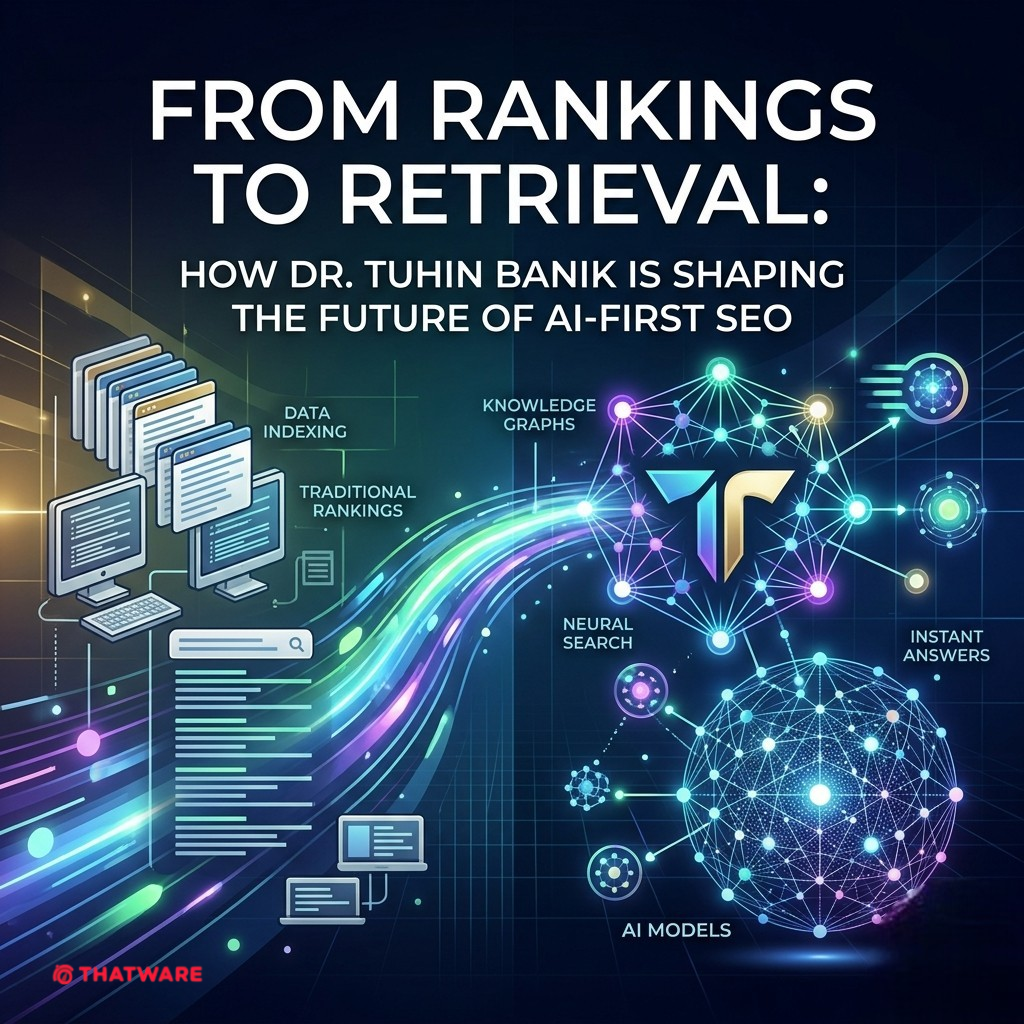
One of the clearest shifts Banik has focused on is the move from search engines as directories to search engines as intelligent assistants.In the old model, users typed short phrases. Search engines returned pages. Users clicked and compared.In the new model, users ask full questions. AI systems interpret meaning. Platforms generate direct responses.This changes the rules completely.If a business is still optimising only for traditional search result pages, it may miss the environments where discovery is increasingly happening:
- AI-generated answers
- Voice interfaces
- Conversational search platforms
- Context-aware recommendation layers
- Predictive search assistance
This is where Banik’s work around Quantum SEO and next-generation frameworks becomes especially relevant. He has consistently argued that modern visibility is no longer just about page rankings. It is about preparing content and site architecture for systems that interpret, summarize, and retrieve information in new ways.That means a brand must be easy to understand, easy to trust, and easy to retrieve.Those are very different goals from simply being keyword-optimised.
The Real Meaning of LLM-Led Search
A lot of people talk about AI in search, but many still reduce it to automation or content generation. Banik’s view is more nuanced.He sees LLM-led search as a structural shift in how information is discovered.Large language models do not just look for exact terms. They process context, relationships, probability, and intent. They infer meaning from language patterns and knowledge structures. This means that content created for old-school ranking formulas may not perform as well in emerging AI-led environments.In practical terms, businesses now need to think about:
- Whether their content answers real human questions
- Whether their site structure supports semantic understanding
- Whether their expertise is reinforced across related topics
- Whether their content can be surfaced in answer-driven experiences
This is where insights from Advancements in AI-driven semantic search technology become highly relevant. The future of visibility will depend on how well brands align with systems that interpret meaning, not just terms.That shift is already underway.
Innovation With Restraint Matters More Than Ever
One of the more grounded parts of Banik’s perspective is that he does not treat AI as a magic solution.He is clearly optimistic about the future of technology, but he also speaks about responsibility. That matters, especially in an industry where AI is often marketed as a shortcut to instant results.Search systems influence how people access information, what sources they trust, and which brands gain authority. When AI enters that process, the stakes become higher.That is why Banik often emphasizes:
- Transparency in optimisation strategies
- Ethical use of automation
- Human oversight in decision-making
- Long-term trust over short-term manipulation
This is a valuable distinction.The future of search will not belong to those who use AI recklessly. It will belong to those who use it intelligently and responsibly.
Final Thoughts
Tuhin Banik’s work stands out because it reflects a deeper understanding of where search is heading. He is not simply reacting to trends in SEO. He is exploring how technology is changing the very nature of discovery online.As search becomes more conversational, predictive, and machine-interpreted, businesses will need more than legacy SEO tactics. They will need systems built for semantic clarity, contextual relevance, and AI retrievability.That is the bigger story here.The next era of digital visibility will not be defined only by rankings. It will be defined by who gets understood by intelligent systems first.And that is exactly the space Tuhin Banik has been preparing for.