Why Contextual SEO Services Are Quietly Replacing Keyword-First Strategies in 2026
Search engines no longer read a page the way they did even three or four years ago. They read intent, relationships between ideas, and how thoroughly a site understands a subject — not simply how many times a phrase shows up on a page. That shift is exactly why more marketing teams are shifting budget toward Contextual SEO services and Semantic SEO services instead of pouring everything into keyword-matching alone. Agencies such as Thatware LLP have watched this transition closely, helping brands rebuild content strategy around topical depth rather than isolated keyword targets. If you're wondering whether this approach is worth the switch, here's what actually changes when you make it.
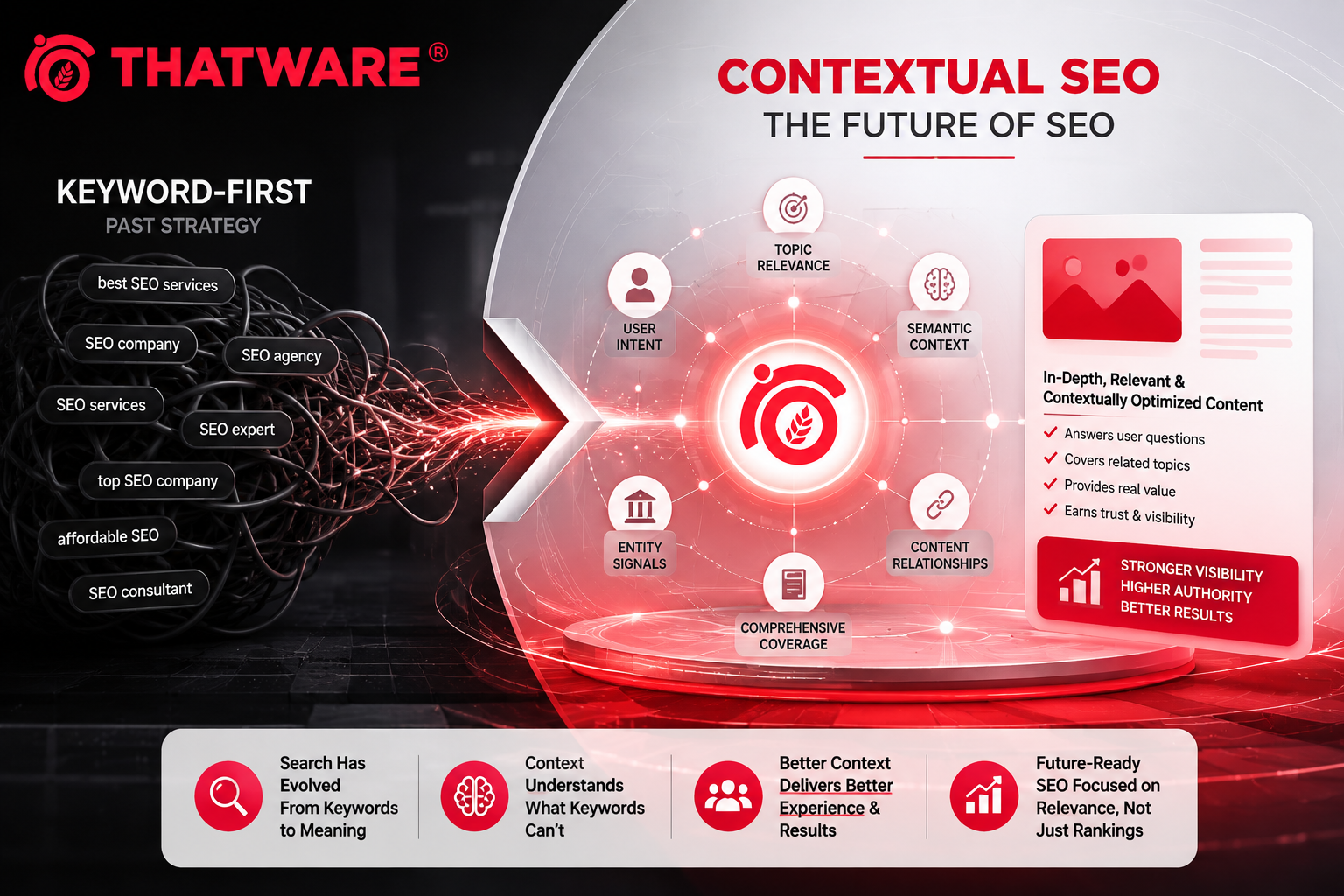
What Are Contextual SEO Services, Really?
At its core, contextual SEO services focus on building topical authority instead of chasing individual search phrases. Rather than asking "what keyword should this page target," the approach asks a bigger question: what does this brand genuinely know about, and how do we prove that across the entire website?That mindset shows up in a few concrete ways:
- Topic cluster mapping instead of standalone keyword lists
- Entity relationships between products, services, and adjacent industry concepts
- Internal linking architecture that mirrors how a real reader — and a search engine — would naturally explore a subject
- Content depth that answers related questions before a reader even has to search for them separately
The result is a website that reads less like a collection of disconnected pages and more like a coherent body of expertise. Search engines reward that coherence because it matches how they've been trained to evaluate authority.
Semantic SEO Services: What Happens at the Execution Level
Semantic SEO services involve considerably more upfront strategy work than traditional keyword SEO. The process typically doesn't start with a spreadsheet of search volumes — it starts with mapping the full subject area a brand wants to own.
- Define the semantic space. Identify every topic, sub-topic, and related question connected to the brand's core offering.
- Audit existing content against that map to find gaps and overlaps.
- Build content briefs that specify not just a topic, but its relationship to adjacent topics and where it sits in a reader's journey.
- Structure internal links so related pages reinforce one another instead of competing for the same territory.
- Monitor entity signals, not just rankings — tracking how consistently the brand is associated with its core subject across the web.
This is noticeably more involved than picking a keyword and writing 1,000 words around it. But that added effort is precisely what produces content that holds its ranking position instead of fading after a few months.
Contextual SEO vs Traditional Keyword SEO
It helps to see the two approaches side by side:
- Keyword SEO targets a specific phrase; contextual SEO services target an entire subject area
- Keyword SEO often needs constant refreshing to stay ranked; a strong contextual strategy compounds over time
- Keyword SEO competes page-by-page; semantic SEO services build pages that support one another
- Keyword SEO can produce fast but short-lived spikes; contextual work tends to build slower, steadier traffic
- Keyword SEO evaluates one page in isolation; contextual strategy evaluates the whole site as a network of related expertise
Neither approach is universally "wrong." A business that needs quick visibility for a seasonal campaign may still lean on keyword targeting. But for brands thinking in years rather than months, contextual SEO services tend to hold up far better against algorithm changes.
Why the Traffic Curve Looks Different
Teams that shift toward semantic SEO services often notice something frustrating at first: the early months can feel slower than expected. Content built around topic clusters takes time to be fully crawled, connected, and understood by search engines. There's no shortcut around that initial investment period.What tends to follow, though, is a traffic pattern that's less erratic. Instead of sharp spikes followed by decline, sites with strong topical structure typically see:
- Steadier month-over-month growth once the cluster is established
- Less volatility during major search algorithm updates
- More long-tail queries ranking automatically, without being individually targeted
- Stronger performance for new content published within an already-established topic cluster
This is one of the most practical reasons brands consider working with a specialist like Thatware LLP — building this kind of architecture correctly the first time saves months of rework later.
Common Mistakes When Adopting Contextual SEO Services
Even well-intentioned teams stumble when they first try to move away from keyword-first thinking:
- Treating clusters as a content calendar exercise rather than a strategic map of the brand's expertise
- Skipping the internal linking work, which is often where most of the semantic value actually gets created
- Publishing isolated articles that don't connect back to a broader topic structure
- Measuring success only by individual keyword rankings, missing the bigger picture of overall topical visibility
- Underestimating the audit phase, which is where existing content gaps and redundancies get identified
Avoiding these mistakes is often the difference between a contextual strategy that compounds and one that stalls halfway through.
Choosing the Right Partner for Semantic SEO Services
Because this approach requires more strategic planning than traditional keyword work, the agency or team executing it matters more than usual. A good partner should be able to explain, clearly, how they map topical relationships — not just how they pick keywords. Thatware LLP's guide to semantic SEO breaks down how this kind of mapping and execution typically works in practice, which is a useful reference point if you're evaluating your own content strategy or comparing providers.It's also worth checking how a prospective partner talks about measurement. If the conversation stays entirely focused on individual keyword rank tracking, that's often a sign the strategy hasn't fully shifted toward a contextual model yet, even if the term gets used in a pitch.
Bringing It Together
The debate between keyword SEO and a more contextual approach isn't really about which one is "better" in the abstract — it's about time horizon. Keyword SEO can still deliver fast, visible wins. But Contextual SEO services and Semantic SEO services tend to produce something harder to replicate: a search presence that's woven into how search engines understand a brand's expertise, not just how well a handful of pages match a handful of phrases.For teams ready to invest in that kind of durability, the payoff is a website that keeps performing with less constant reinvestment. If you're evaluating whether your current content strategy is built for that kind of longevity, exploring Thatware LLP's approach to semantic SEO services is a reasonable next step before committing budget in either direction.
Frequently Asked Questions
1. What is the main difference between contextual SEO and traditional keyword SEO?
Contextual SEO services build authority around an entire subject area using topic clusters and internal linking, while traditional keyword SEO optimizes individual pages around specific search phrases.
2. How long does it take to see results from semantic SEO services?
Most brands see a slower initial ramp-up — often the first 6 to 12 months — followed by steadier, more compounding growth compared to keyword-only strategies.
3. Are semantic SEO services only useful for large websites?No. Smaller sites often benefit even more, since a well-mapped topic cluster helps a limited number of pages punch above their weight by reinforcing each other's relevance.
4. Does contextual SEO replace the need for keyword research?
Not entirely. Keyword research still informs which topics and questions matter most; contextual SEO simply organizes that research around subject-wide authority instead of isolated phrases.
5. How do I know if my current SEO strategy is keyword-first or contextual?
If your content calendar is built from a keyword list with little connection between articles, it's likely keyword-first. If pages are mapped around a topic structure with deliberate internal linking, it's closer to a contextual approach.